.png)
The Nancy Grace Roman Telescope

Hello Universe!
Today, I’m going to be talking about NASA’s Nancy Grace Roman Telescope that launched just last month, and what it means for the future of space exploration.
Who was Nancy Grace Roman?
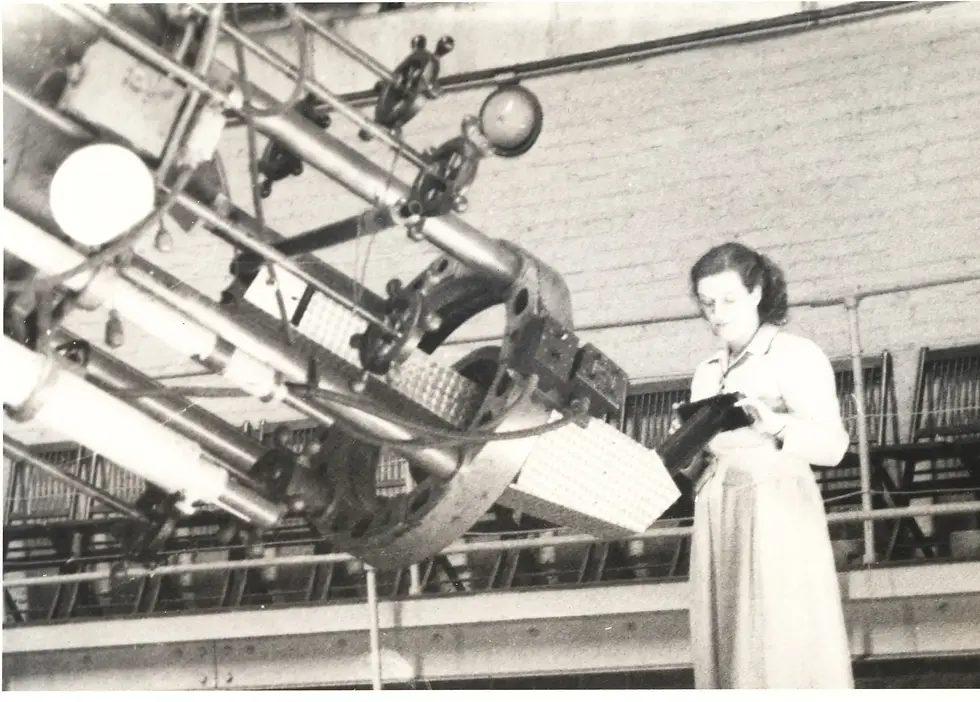
Also known as the “mother of the Hubble Space Telescope,” she was born May 16, 1925, in Nashville, Tennessee, and died December 25, 2018. She was interested in astronomy from a young age and received her Bachelor of Arts degree in Astronomy from Swarthmore College. She received her Ph.D. from the University of Chicago and stayed at the university for another six years, working at the Yerkes Observatory. During this time, she observed the star AG Draconis and discovered that its emission spectrum had completely changed.
This boosted her astrophysical career, and she went to work at the Naval Research Laboratory and entered into the new field of radio astronomy. This change was also due in part to gender-related challenges, such as not receiving tenure. In the new program, she used spectra of non-thermal radio sources, conducted geodetic work, and later became head of the microwave spectroscopy section. She received an offer to create a space-based astronomy program at NASA, joined the team as the first female executive at NASA, and became the first Chief of Astronomy.


Part of her job included planning a program of satellites and rockets, and one of the biggest challenges of her career was securing approval for the Hubble Space Telescope from the U.S. Congress. She believed the telescope’s most interesting discovery was dark energy. Hubble also confirmed the initial measurements showing that the expansion of the universe was accelerating and extended them to higher redshifts. NASA dedicated its next major space observatory, tasked with increasing our understanding of dark energy, the universe, and our place in it, to her, the pioneer of modern space-based astronomy, who made telescopes like these a reality.
The Roman Observatory
The Nancy Grace Roman telescope will help solve some of the most profound mysteries in astrophysics. To enable its sensitive measurements, the telescope will observe from a variety of points about 930,000 miles from Earth, in the direction opposite the Sun. At this point, called the second Sun-Earth Lagrange point, gravitational forces balance, keeping objects in orbit with very little assistance. Its barrel-like shape will help block out unwanted light from the Sun, Earth, and Moon, and its distant location will keep the objects cool. The thermal stability of an observatory and Lagrange 2 will provide a tenfold improvement over Hubble in much of the data Roman will gather.
The detail that these observations shall reveal is related to the size of the telescope’s mirror. A larger surface gathers more light. Roman’s primary mirror is 7.9 feet across. While it is the same size as Hubble’s main mirror, it is less than one-fourth the weight. Its mirror weighs only 410 pounds. It was launched on a SpaceX Falcon Heavy rocket from Cape Canaveral, Florida, on August 30, 2026.
Wide Field Instrument
A 300-megapixel infrared camera that will allow scientists to look very far back in time, seeing the universe in its early stages, to unravel how it has expanded throughout its history.
Coronagraph
Demonstrates technology that eliminates the glare of nearby stars and allows astronomers to directly image planets in orbit around them, being far more powerful than any other coronagraph flown
Image of the Wide Field Image of the Coronagraph
Instrument (Credit: NASA) (Credit: NASA)
Nancy Grace Roman Telescope in the NASA Goddard Space Center
The telescope was fully assembled and tested in the largest clean room at NASA’s Goddard Space Flight Center in Maryland. I had the opportunity to visit this room and see the telescope in the summer of 2025, just a month before it was shipped to be prepped for launch. It is incredible that I was able to see the telescope that is now en route to observe the universe in new ways and help solve some of the largest questions about space.
Images from my visit to the NASA Goddard Space Center in Maryland in the summer of 2025.


